I have heard the phrase “Good things come to those who wait” way too many times. It’s not true. It’s more like “Slow things come to those who wait” - everyone else is gone by that time.
Why things happen slowly gives me a daily source of frustration, especially when the slowness is a bug, not a feature. (Yes, I don’t work with trees. 🌴🌳)
One reason companies never get things done on time is doing too many things at the same time. At least we are trying.
Every company / team I’ve seen was trying to do this. This kind of place is instantly recognisable after you’ve seen one:
- ”Everything takes forever”
- Meetings where people are only half there
- “Special project teams” / “Tiger teams” (that nevertheless go nowhere, but make a lot of noise)
- Everyone is extremely busy all the time, but little real progress
- More time spent on tracking projects than doing the work (still inaccurate, though)
- Always waiting for some other team to finish their work
- Starting new projects because “we were blocked on that other one anyway”
- Sometimes a silver bullet arrives (and doesn’t work out)
- Lots of planning in progress. Plans get irrelevant before the work starts.
- Lots of discussions on “utilisation”: “We need to keep everyone busy” (I thought you wanted to get things done)
- Low trust levels. Calls for “accountability”, “ownership” and “predictability”
Do less to do more
What’s too many?
More than one per person. (Walking and chewing gum at the same time excluded.)
Peter Thiel at PayPal famously had a simple rule: you were responsible for exactly one thing. He was only talking to you about that one thing. As soon as you brought up any other topic, he just left.
But people should be able to multitask
Well, we can’t. You cannot do two things that involve thinking and concentration at the same time. You can try switching back and forth. This is what computers do, but they do it so fast that it seems like they do many things simultaneously. You are not a computer.
But hey, let’s try. Here is what happens:
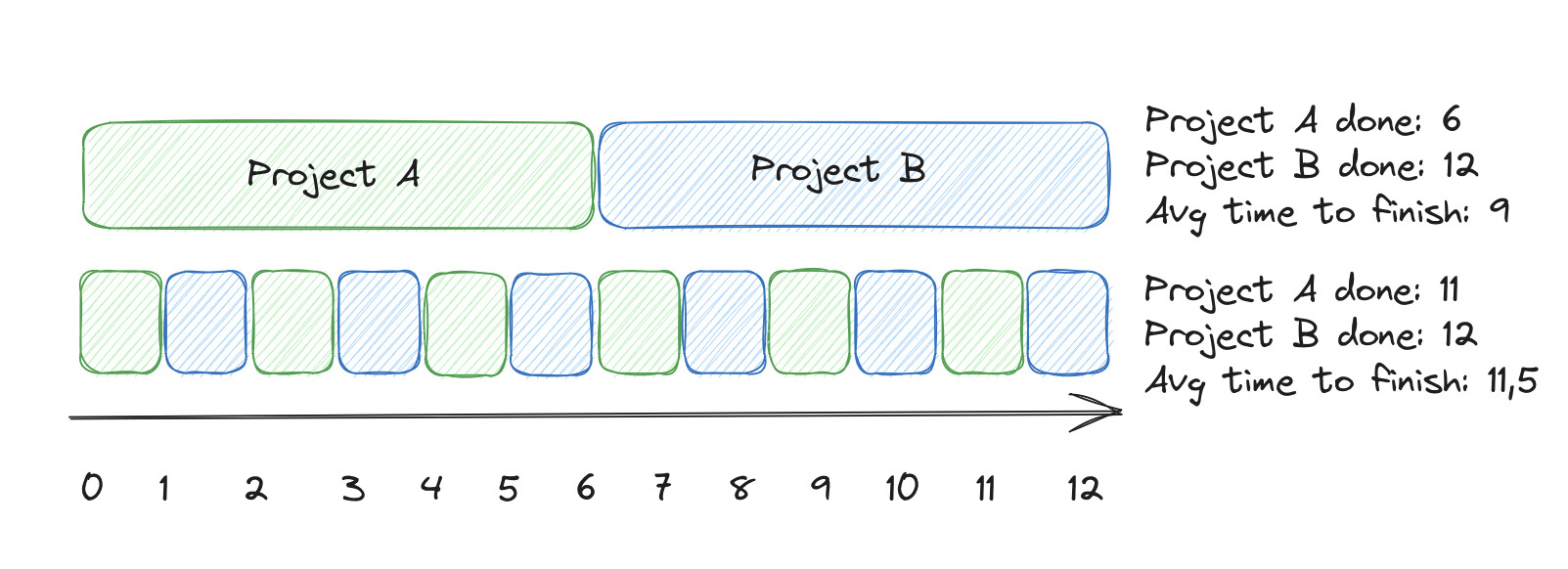
No alt text provided for this image When you do two things at the same time, on average, you will be slower.
But there’s a catch: I just assumed you can switch between things in an instant, (and all the tools you need can do the same) and have the full context in your mind about both projects at the same time. Which you cannot.
Really, the second line will end somewhere around 18, if you’re lucky (and good.)
But why do we do it?
Everyone loves the warm and fuzzy feeling of ‘my things are being worked on’.
Whoever needs project B, is very anxious while waiting for someone to start working on it. (In the second case, you’ll be in meetings with both project A and B folks, asking if you can 1. go faster or 2. just work on their thing.)
But you see, we have many people
If everyone keeps waiting for each other, this does not really matter. If you have completely independent teams, all this does not apply to you (only on a team level), but it’s hard to be completely independent when you work on the same thing.
Stop starting; start finishing
Many people have the right instinct for what to do when things hit the fan (we just forget / don't use it in other cases):
Stop whatever you are doing Figure out what needs to be done and where you are with that Pick the first thing that brings you closer to finishing. Finish that one thing. Don’t start a new thing before the current one is done. (Really done, not just “handed over to QA” done).
Results come from finished things, not ones in progress
It’s tempting to add more people. Ask for more money. More “resources”. Outsource. Do anything that involves “more”.
Brook’s law still stands:
“Adding manpower to a late software project makes it later”
(The Mythical Man-month is an old but still very relevant book)
Focus. Do one thing. Finish that thing. Repeat.